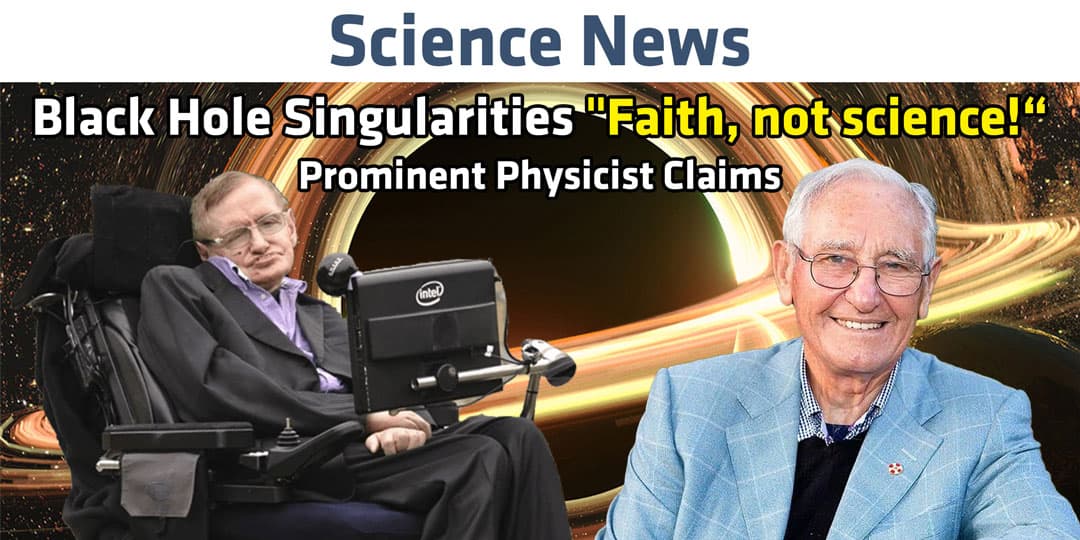
Black Hole Singularities "Faith, not science!" Prominent Physicist Claims
About this video
This video titled "Black Hole Singularities 'Faith, not science!' Prominent Physicist Claims," was published by Sabine Hossenfelder on December 13, 2023, in the Science & Technology category. In this video, Hossenfelder discusses a surprising development in theoretical physics concerning a claim by a renowned physicist about a mistake in a proof dating back half a century, suggesting that black holes might not actually contain singularities.
The physicist in question is Roy Kerr, known for his contributions to general relativity, particularly in mathematically describing rotating black holes in Einstein's theory. Kerr's new claim challenges the Hawking-Penrose Singularity Theorems, which assert that black holes must contain singularities. Kerr argues that the proof by Hawking and Penrose draws incorrect conclusions from certain parameters, and the end of these parameters does not necessarily imply the presence of a singularity. He suggests that the belief in singularities inside black holes is more a matter of faith than science.
Hossenfelder points out that Kerr's argument is likely mathematically correct and highlights that many theoretical physicists, including herself, overlooked this relatively simple argument. She raises three key points: First, just because the proof of singularities in black holes is incorrect doesn't mean the conclusion is wrong. Second, there are other reasons physicists believe black holes lead to singularities, mostly related to the physical aspect of matter compression beyond a critical density. Third, most physicists don't think there are singularities inside black holes anyway, expecting quantum effects of spacetime to become significant near them. Hossenfelder notes that Kerr's argument is novel in suggesting that quantum spacetime effects are not needed to eliminate singularities.
This video is particularly intriguing for those interested in theoretical physics and the mysteries surrounding black holes.
Original source