Why do the Planets Orbit in a Plane?
About this video
The night sky is filled with bright dots. Historically, people believed these stars formed a shell around Earth. However, some bright dots, which move against other stars, are planets—derived from Ancient Greek, meaning "Wandering Star." These planets, along with the Sun and Moon, all lie on the ecliptic, a specific path that goes through 12 constellations known as the zodiac. Constellations are arbitrary patterns identified by ancient civilizations, distinct from the science of astronomy.
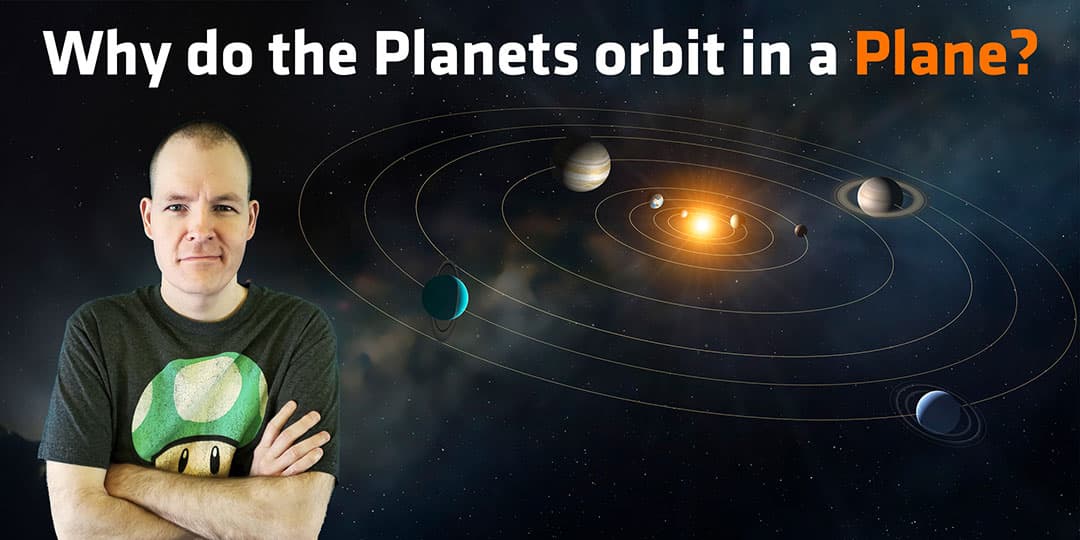
The reason why all these celestial bodies are on the ecliptic relates to the 3-dimensional thinking. The orbit of Earth around the Sun, known as the "Plane of the Ecliptic," is where most planets also orbit, with inclinations less than 10 degrees. The cause for this alignment dates back to 5 billion years ago when the solar system was a gas and dust cloud. Gravity caused this cloud to collapse and eventually turn into an "Accretion Disk," leading to the formation of planets.
The shape of these celestial objects, whether disk or sphere, depends on outward pressure from collisions and angular momentum from spinning. Loosely packed matter forms a disk due to dominating angular momentum, while densely packed matter becomes a sphere from outward pressure. Both the Earth and Sun exhibit a bulge at their equator because of this angular momentum. Meanwhile, many asteroids and comets are lumpy, being in a middle state between disk and sphere.
Original source