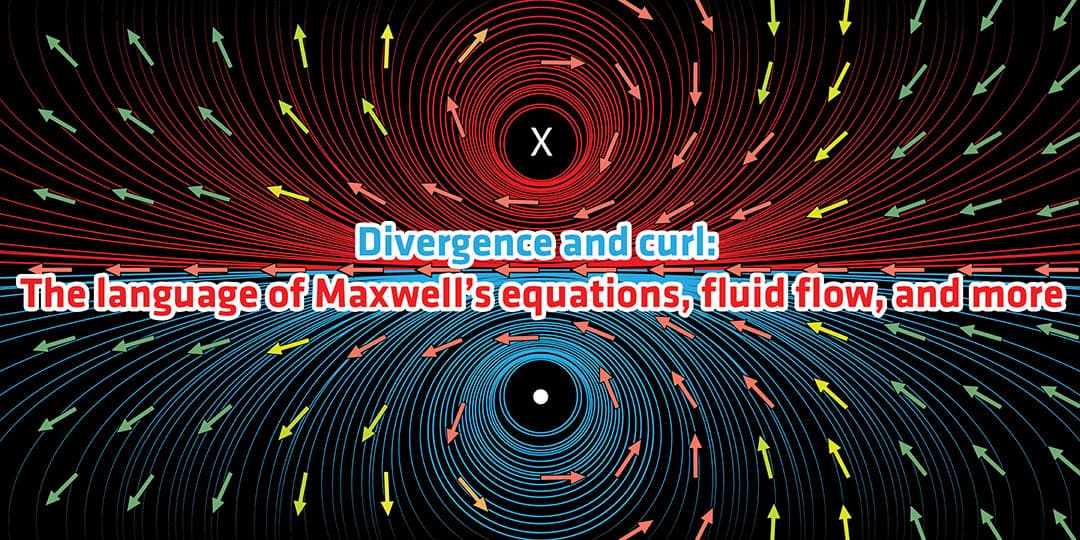
Divergence and Curl - The language of Maxwell's equations, Fluid flow, and more
About this video
Vector Fields: These are functions associating each point in space with a vector, which could represent various physical quantities like particle velocities or gravitational forces. We mainly focus on two-dimensional fields for simplicity.
Interpreting Vector Fields: It can be helpful to understand a vector field by imagining it representing a different physical phenomenon.
Divergence: This is a measure of how much a hypothetical fluid represented by the vector field tends to flow in or out of small regions near a point. Positive divergence signifies a source, while negative signifies a sink. Incompressible fluids have zero divergence everywhere.
Curl: This measures the tendency of the hypothetical fluid to rotate around a point. Clockwise rotation signifies positive curl, and counterclockwise signifies negative curl.
Applications: Divergence and curl are important for fields like electricity and magnetism, as exemplified in Maxwell's equations.
Notation and Computation: Divergence and curl are often expressed using dot and cross products with the nabla (gradient) operator. This notation reflects a real connection between these operations.
Dot and Cross Product Relation: Divergence can be seen as an average value of the dot product of a step vector with the difference vector caused by that step, while curl is an average of the cross product of the step vector and the difference vector.
These concepts play a crucial role in physics, engineering, and related fields, especially when applied to physical phenomena and differential equations.
Original source