Dubbed
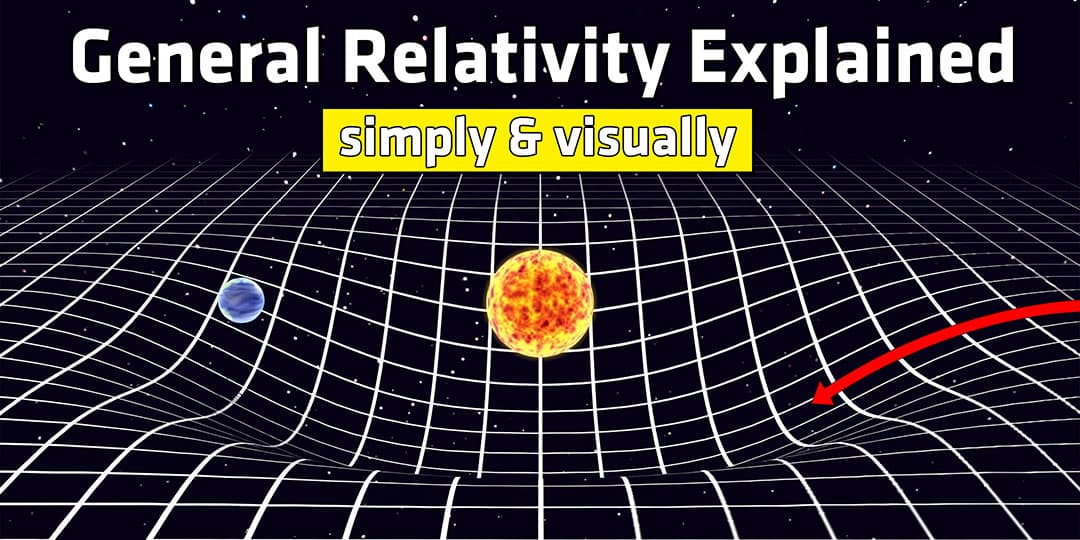
General Relativity Explained Simply & Visually
About this video
Albert Einstein, while renowned today as one of the brightest minds in history, wasn't always so widely accepted. In the early 1900s, from the confines of a patent office, he proposed ideas that would challenge centuries of scientific understanding. His Special Theory of Relativity, which was initially met with skepticism, was only part of his vision. Einstein felt it wasn't complete; it didn't account for gravity or acceleration. Then, a seemingly ordinary sight—a window washer on a ladder—inspired him. From the perspective of a falling man, Einstein realized, gravity wouldn't be felt at all. This was a profound connection: gravity and acceleration were interlinked.
This sparked a deeper exploration. Imagine, he thought, if you were in a windowless room. Would you know if you were on Earth or in a spaceship accelerating in space? Your weight would be the same in both scenarios. But what if you shone a light across the room? On Earth, the light's trajectory seems straight. But on an accelerating spaceship, or in a gravitational field, light would appear to curve. Einstein's realization was that light was still traveling the shortest path—it's just that the very fabric of space itself was curved by gravity.
However, transforming this idea into the framework of General Relativity wasn't straightforward. Einstein sought the expertise of Marcel Grossman, a mathematician familiar with the geometry of curved spaces. With Grossman's help, Einstein proposed that space-time was like a fabric, woven together and distorted by mass and energy. This revolutionary idea explained the mysterious precession of Mercury's orbit, a puzzle that had baffled scientists.
But for the world to accept this radical theory, a tangible proof was needed. This came when, during a solar eclipse in 1919, English Astronomer Arthur Eddington observed that starlight passing near the Sun was bent, aligning with Einstein's predictions. Almost overnight, Einstein's fame skyrocketed.
Yet, even with General Relativity's immense success in describing the vastness of the universe, mysteries remain. The theory breaks down in extreme conditions, like the heart of black holes. And in the realm of the very small, quantum mechanics, another pillar of modern physics, seems incompatible with it. Scientists today are on a quest to reconcile these two giants of physics, hoping to uncover a unified theory of quantum gravity.
Original source